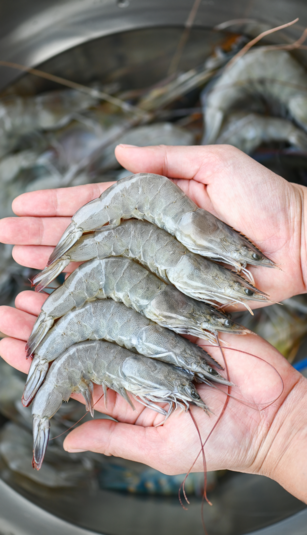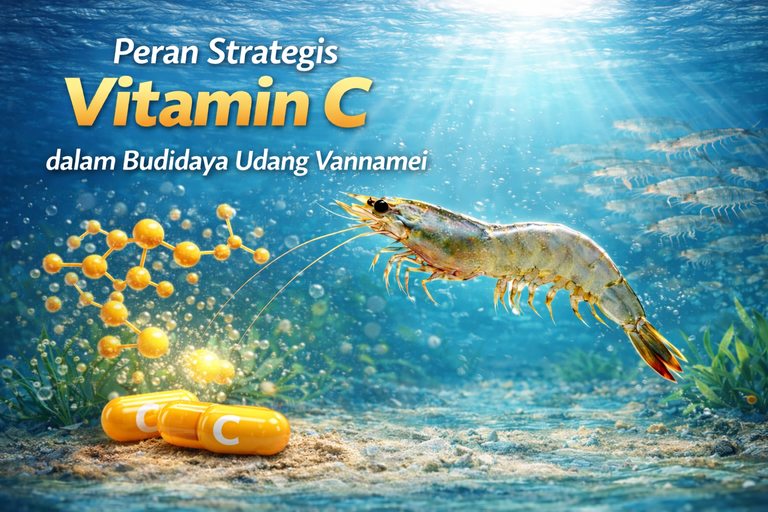

The Strategic Role of Vitamin C in Vannamei Shrimp Aquaculture
Vannamei shrimp aquaculture (Litopenaeus vannamei) is currently developing toward intensive and super-intensive systems, characterized by high stocking densities, large feed inputs, and rapid fluctuations in environmental quality. Under such conditions, nutrition no longer functions solely as a source of energy and growth, but also as a determining factor of shrimp physiological resilience and health. One nutrient that plays a crucial role is vitamin C (ascorbic acid).
Unlike some other organisms, shrimp are unable to synthesize vitamin C endogenously. Therefore, vitamin C requirements depend entirely on dietary supply or additional supplementation. Vitamin C deficiency has been proven to directly result in reduced growth, increased susceptibility to environmental stress, and weakened shrimp immune systems.
- Vitamin C as an Essential Nutrient in Vannamei Shrimp
Vitamin C is a water-soluble vitamin that functions as a cofactor in various important biochemical reactions. In vannamei shrimp, this vitamin is categorized as an essential nutrient, as its absence cannot be compensated by internal physiological mechanisms. Vitamin C deficiency may cause impaired tissue formation, weakened exoskeletons, slow post-moulting recovery, and increased mortality. In the context of intensive aquaculture, where shrimp are continuously exposed to osmotic stress, fluctuating water quality, and pathogenic pressure, the role of vitamin C becomes increasingly significant. - Primary Physiological Functions of Vitamin C
- Collagen Synthesis and Exoskeleton Health
One of the primary functions of vitamin C is supporting collagen synthesis. Collagen is a key structural component of connective tissue and plays an important role in the formation and strengthening of shrimp exoskeletons. Adequate vitamin C intake helps accelerate exoskeleton hardening after moulting and speeds up wound recovery caused by abrasion, mild cannibalism, or handling during sampling. With stronger exoskeletons and faster tissue recovery, mortality risk due to tissue damage can be significantly reduced. - Antioxidant Activity and Stress Management
Vitamin C also functions as a powerful antioxidant capable of neutralizing free radicals. In intensive ponds, free radicals may form due to osmotic stress, salinity fluctuations, temperature changes, and accumulation of toxic metabolites. If not neutralized, free radicals will damage cell membranes and disrupt shrimp metabolism. The antioxidant role of vitamin C helps maintain shrimp physiological stability, indirectly improving feed utilization efficiency and Feed Conversion Ratio (FCR).
- Collagen Synthesis and Exoskeleton Health
- The Role of Vitamin C in the Shrimp Immune System
- Activation of Non-Specific Immunity
Shrimp rely on non-specific immune systems as their primary line of defense. Numerous studies indicate that vitamin C supplementation can increase serum lysozyme activity, activate alternative complement pathways, and enhance phagocytic activity and respiratory burst in hemocytes. Improved immune parameters enable shrimp to better withstand pathogenic pressure in pond environments. - Protection Against Vibrio Infection
Bacterial pathogens from the genus Vibrio, such as Vibrio harveyi and Vibrio parahaemolyticus, are major causes of bacterial diseases in shrimp aquaculture. Vitamin C strengthens natural immune responses, thereby suppressing the development of Vibrio infections more effectively, particularly during critical culture phases. - Evidence from Vitamin C Bioencapsulation
Vitamin C bioencapsulation through Artemia salina has also shown promising results, particularly during larval stages. Administration of vitamin C at a dose of 50 ppm via Artemia produced the highest Total Haemocyte Count (THC), reaching up to 41 × 10⁴ cells/mm³, with an optimal hemocyte composition of approximately 66.67% hyaline cells. This condition reflects a more prepared and responsive larval immune system to environmental challenges.
- Activation of Non-Specific Immunity
- Vitamin C Requirements and Application in Aquaculture Practice
Classic research by He et al. (1993) demonstrated that the minimum vitamin C requirement for optimal survival of vannamei shrimp reaches 120 mg AAE/kg feed. In field practice, dosage recommendations are generally adjusted according to culture stage. During the postlarval stage, vitamin C requirements range between 80–120 mg/kg feed, while during the grow-out phase, ≥100 mg/kg feed is recommended. To maintain effectiveness, the vitamin C form used should be a stable form, such as L-ascorbyl-2-polyphosphate, which is more resistant to feed processing, storage, and degradation in water. For shrimp weighing more than 5 grams, increasing vitamin C dosage up to 260 mg/kg feed does not always result in significant additional growth. However, such levels remain important for maintaining general health, immunity, and resistance to chronic stress in intensive ponds. - Practical Implications for Pond Management
Vitamin C should not be regarded merely as an additional supplement, but as part of a preventive nutritional strategy. Proper vitamin C application helps farmers reduce disease risk, enhance shrimp resilience to environmental fluctuations, and maintain sustainable culture performance. In modern aquaculture systems, integrating vitamin C with feed management, water quality control, and biosecurity measures has become an increasingly relevant approach to achieving optimal productivity.
Vitamin C is a key functional nutrient in vannamei shrimp aquaculture. Its roles include supporting exoskeleton health, protecting against oxidative stress, enhancing immune function, and contributing to feed efficiency. With appropriate dosage and formulation, vitamin C forms an essential foundation for maintaining shrimp health and ensuring successful aquaculture, particularly in intensive and super-intensive systems.
References
- He, H., et al. (1993). Vitamin C requirements of the shrimp Penaeus vannamei. Aquaculture, 118(4), 317–326. https://doi.org/10.1016/0044-8486(93)90305-I.
- Liu, A., et al. (2024). Vitamin nutrition in shrimp aquaculture: A review. Aquaculture, 574, 740248. https://doi.org/10.1016/j.aquaculture.2023.740004.
- Ardiansyah, A., et al. (2023). Immune Response of Vannamei Shrimp Larvae. Jurnal Galung Tropical, 12(1). https://doi.org/10.31850/jgt.v12i1.990.
- Evaluation of vitamin C-enriched Artemia nauplii. https://www.vliz.be/imisdocs/publications/ocrd/2582.pdf.