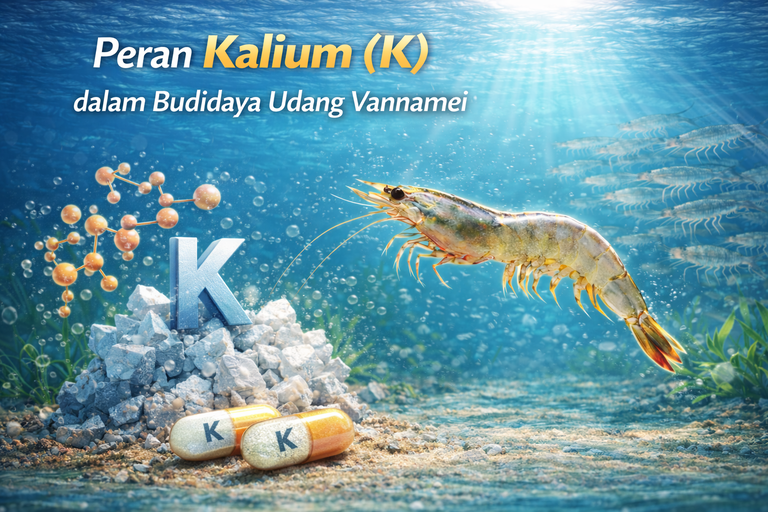

The Role of Potassium (K) in Vannamei Shrimp Aquaculture
Potassium (K) is an essential mineral that plays a highly crucial role in vannamei shrimp aquaculture (Litopenaeus vannamei). The role of potassium is not limited to fulfilling mineral requirements, but is also directly related to the physiological stability of shrimp and the quality of the culture environment. Based on various studies, potassium has been shown to have a significant impact on osmoregulation processes, metabolic efficiency, growth, moulting success, and ionic balance in aquatic environments.
- Optimization of Osmoregulation RateThe primary benefit of potassium in vannamei shrimp culture is its role in supporting osmoregulation, which is the shrimp’s ability to regulate osmotic pressure balance between body fluids and the rearing medium. In low-salinity waters, differences in ion concentration between the shrimp body and its environment become greater, requiring shrimp to work harder to maintain internal balance. Research conducted by Widodo et al. (2011) in Jurnal Riset Akuakultur showed that potassium supplementation in the range of 50 to 55.05 mg/L was able to significantly reduce osmotic load, with values ranging from 209.80 to 479.33 mOsm/kg. In contrast, in media without potassium supplementation, osmotic load could increase to approximately 772.00 mOsm/kg. Lower osmotic load allows shrimp to remain physiologically stable and less susceptible to stress when facing changes in water quality.
- Metabolic Efficiency and Oxygen ConsumptionPotassium plays a direct role in shrimp energy metabolism by regulating intracellular ionic balance. When potassium levels are optimal, shrimp do not need to expend excessive energy to maintain ionic homeostasis. Research by Widodo et al. (2011) in Jurnal Riset Akuakultur demonstrated a very strong correlation between potassium concentration and shrimp oxygen consumption, with a correlation value reaching 98.9 percent. This indicates that better potassium balance in the water leads to more efficient oxygen and energy use by shrimp. Energy saved from osmoregulation processes can then be allocated to tissue growth and overall physiological performance.
- Improved Growth Rate and SurvivalConsistent potassium supplementation has been proven to positively affect growth rate and survival of vannamei shrimp, particularly during postlarval or juvenile stages that are highly sensitive to environmental changes. Research by Iskandar et al. (2025) published in Grouper: Jurnal Ilmiah Perikanan confirmed that potassium supplementation in freshwater media significantly increased absolute growth and shrimp Survival Rate compared to treatments without potassium. Shrimp reared in media with adequate potassium levels exhibited faster growth, more uniform size, and better survival capacity, thereby reducing the risk of culture failure during early stages.
- Supporting the Success of the Moulting ProcessAs explained by Marlina et al. (2005) in the Egyptian Journal of Aquatic Biology & Fisheries, potassium also plays an important role in supporting successful moulting, a critical phase in the shrimp life cycle. This mineral works synergistically with calcium and magnesium in the formation and hardening of the new exoskeleton after moulting. Potassium deficiency is often associated with moulting disorders, failure of shell hardening, and increased incidence of sudden mortality in ponds. With adequate potassium availability, moulting can proceed more smoothly, allowing optimal shrimp growth and minimizing mortality risk due to exoskeleton disorders.
- Maintaining Ionic Balance in Pond Waters
Potassium is an essential mineral that plays a strategic role in vannamei shrimp aquaculture, particularly in low-salinity to freshwater ponds. Through its roles in osmoregulation, metabolic efficiency, growth, moulting success, and ionic stability, potassium directly contributes to improved biological performance and shrimp resilience. Proper potassium management not only supports shrimp health but also forms an important foundation for stable, efficient, and sustainable aquaculture systems.
References